In development. Nothing is shipped yet.
Your SDS binder, but it answers questions — and shows you where it got the answer.
Bench is your lab's own chemical inventory and SDS record. Ask a safety question and Bench answers with the exact words from the manufacturer's sheet you uploaded, names the section they came from, and links the PDF. It never writes safety advice of its own.
We're looking for synthetic chemistry labs to build this with. You'd be talking to the person writing the code, not a sales team.
Right now the record is a spreadsheet and the answer is in a binder.
Plenty of labs keep the inventory in Excel and the sheets in a binder, a shared drive, or a browser tab. The spreadsheet drifts the moment someone opens a new bottle. The binder is complete and accurate and nobody reads it, because finding one line about skin contact in a fourteen-page PDF while you're standing at the hood is slower than asking whoever is next to you.
Bench isn't trying to replace your campus system. Excel is usually the format your campus asks for anyway — Bench imports it and exports it.
Answers that quote the sheet, not the internet
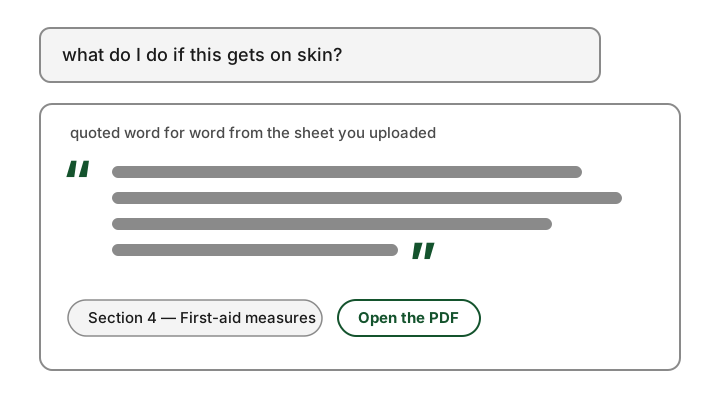
Ask "what do I do if this gets on skin?" Bench finds the passage in the SDS your lab uploaded, quotes it word for word, names the section it came from, and links the PDF so you can read the rest yourself. It never paraphrases hazard, first-aid, or incompatibility text. If the sheet doesn't answer your question, Bench says "not found in this SDS" and opens the PDF rather than guessing.
The sheets are yours. Bench doesn't ship a library of generic third-party SDSs — you upload the manufacturer's own sheet for the product actually on your shelf, which is the sheet hazard communication is about.
A chemical record that outlives the people who made it
What's on the shelves, where it is, how much is left, and who owns it — with the who, where and when kept as a record, because chemical identity and where it was used is a thirty-year record under 29 CFR 1910.1020. Bench archives instead of deleting: an archived container still exports.
Import the spreadsheet you already have. Export the file your campus already asks for.
Stocking the shelves: photograph a label and Bench reads the fields off it — everything it reads arrives unconfirmed and flagged until a person accepts it. Bench would rather leave a CAS number blank than invent a plausible one.
When the student who set it all up graduates, ownership hands over in one step and the whole lab exports.
Works when the power is out, and when the answer has to be on paper
Hazard communication requires a sheet to be available during the work shift, including when systems are down. So print and offline export aren't a fallback, they're part of the product: print the binder, export the inventory, keep the PDFs. A login-gated chat is never the only route to a sheet.
Built for whoever got handed the chemical hygiene folder
Usually that's the lab manager. In smaller groups it's the senior grad student or the postdoc who inherited the job along with the desk. Bench is set up by the lab, in an afternoon, with no institutional site license, no procurement cycle and no EHS project.
What Bench is not: an enterprise EHS platform, a marketplace, or a replacement for a system your campus mandates. It never sends an email, an order, or a report on your behalf — procurement messages are drafts you read and send yourself.
The part your IT security review will ask about
Most universities review software regardless of what it costs, and at some campuses anything with AI in it gets reviewed by definition. So, in advance and in plain language:
- No personal data by design. Bench stores chemical container records, plus a name and an institutional email to sign in. No student records, no health information, nothing that raises the data classification.
- Print and offline access to every sheet, so the sheet stays available on paper or as an exported file whether or not Bench itself is up.
- Thirty-year retention is in the data model. Records are archived, never hard-deleted, and archived records still export.
- Your data leaves in a standard format whenever you want it — Excel in, Excel out, plus a full export of the lab.
- Accessibility: the product and this website are built to target WCAG 2.1 AA, and a VPAT will accompany the product.
- We are building toward HECVAT v4.1.5 answers, and documenting the AI data flow: what text is sent to the model, what is retained, and how to switch it off. Single sign-on (SSO/SAML) is a design constraint from day one, not a later add-on.
- This website sets no cookies, runs no analytics, loads no fonts or scripts from anywhere else, and makes no third-party requests at all. Open your browser's network panel and check — every byte comes from get-bench.com.
Bench is early. That list is the posture we are building to, not certifications we hold. We don't claim to be OSHA, FERPA, HECVAT or WCAG "compliant", "certified" or "approved" — and you should be suspicious of any lab tool that does.
Questions and answers
Is this Benchling?
No. Bench is independent and unaffiliated — no connection to Benchling, Inc. or Bench Accounting. The name collision is genuinely annoying; if you're trying to find us again, get-bench.com is the reliable route.
Our campus already requires ChemTracker / SciShield / something else. Does this replace it?
No, and it shouldn't. Bench doesn't replace a campus system — it exports the file you already submit to one. Check your own department's policy before running anything alongside a required system; we don't make claims about what your campus permits.
Can I trust an AI with safety information?
You shouldn't, and Bench doesn't ask you to. It quotes the manufacturer's sheet and links the PDF. It never paraphrases hazard, first-aid or incompatibility text, and when the sheet doesn't answer the question, it says so.
What happens when the student who set it up graduates?
One-step ownership handoff and a full export of everything the lab has. What hands over is the access, not just the data — the next person takes the lab over under their own institutional sign-in, so the sheets and the inventory are still there after a graduating student's email stops working, rather than something to rebuild from an export. It's designed in from the start, because lab turnover is the thing most likely to kill a tool like this.
What if you go down, or we lose network?
Print your SDS binder and export your inventory any time you like. They're yours, as files. Getting to a sheet immediately never depends on us being up.
What do you do with our data?
It's your lab's record. You can export all of it, any time, in Excel. Before anyone's real data is in the system we'll publish exactly what text gets sent to the AI model, what's retained, and how to turn it off.
What does it cost?
Pilot labs get it free while we're building. We'll talk about price with you before there is one.
Request early access
Bench is being built right now. If you run inventory or safety for a synthetic chemistry lab, we want to talk to you before more of it is built — what you say shapes what gets made.
Email dq7338@g.rit.edu and tell us your institution and department, roughly how many containers you're responsible for, and what you use today.
There's no form, no account, and nothing to sign up for — which is also why this page can promise it collects nothing. A person reads these; replies take a few days.